21May

7 Signs Your Business Already Needs an Outside Recruiter

Most companies only contact an outside recruiter when hiring has already become a serious problem.

Positions stay open for months.
Teams become overloaded.
Management spends too much time searching for people.
And the business starts losing momentum.

But in reality, the need for strategic recruitment support usually appears much earlier.

Below are 7 signs that often indicate your business already needs an external recruitment partner.

01Apr

Why Recruitment Services Have Strategic Value in the Ticino Market

The labor market in Ticino is not just a local market.
It is a compact, highly competitive, and to a large extent closed ecosystem.

On one side, there is a high number of small and medium-sized businesses, often operating with limited internal resources.
On the other, there is a shortage of qualified professionals and strong competition for top talent.

At this intersection, a key question emerges:
why is recruitment today no longer an option, but a strategic necessity?

1. The illusion of choice: many candidates, few truly suitable

At first glance, the market appears active: vacancies are published, applications are received.

But behind the volume lies a quality issue.

Companies regularly face the following challenges:

  • candidates do not match the level of responsibility required
  • experience exists on paper but is not relevant to the specific business context
  • lack of cultural fit within the team
  • soft skills do not align with the company’s working dynamics

As a result, the hiring process becomes a “CV screening exercise” rather than a strategic selection.

 The true value of recruitment lies in filtering and interpretation,
not simply in sourcing.

A strong recruiter evaluates not only experience, but also potential, motivation, and alignment with the business context.

2. The passive talent market: where the best candidates really are

One of the defining characteristics of Ticino is its limited talent pool.

At the same time:

  • most strong professionals are already employed
  • they are not actively looking for new roles
  • they are not present on job boards

This is what we call the “passive market.”

 And this is where real competition between employers takes place.

Accessing these candidates requires:

  • direct search
  • personalized outreach
  • trust and reputation

Recruitment agencies act as a bridge between companies and this hidden talent market.

3. The cost of a hiring mistake: hidden business losses

Hiring mistakes are often underestimated.

Companies tend to consider only salary costs, while ignoring the real impact:

  • management time spent on hiring and onboarding
  • lost opportunities (delayed projects, slowed growth)
  • negative impact on team performance and engagement
  • reputational risks

In smaller teams, this impact is significantly amplified.

 One wrong hire can cost not only money, but also momentum.

Professional recruitment reduces this uncertainty through:

  • more accurate candidate evaluation
  • structured processes
  • clear alignment of expectations and motivation

4. The absence of a structured HR function

In Ticino, many companies do not have a dedicated HR function.

Typically:

  • responsibilities are split between management and administration
  • there is no structured hiring process
  • decisions are often made intuitively

This leads to:

  • unclear role definitions
  • misaligned expectations within the team
  • lack of evaluation criteria

 In this context, a recruitment agency is not just a supplier,
but a strategic partner.

It brings structure where there is none.

5. Recruitment as a business diagnostic tool

One of the most underestimated aspects of recruitment is its diagnostic role.

Before starting a search, it is essential to understand:

  • what problem the new hire needs to solve
  • what the real priorities are
  • which competencies are truly critical

Very often, it becomes clear that:

  • the role is too broadly defined
  • expectations are unrealistic
  • or the company is looking for a “perfect candidate” who does not exist

 A strong recruiter helps refine and clarify the role before the search begins.

This alone can save months.

6. Time as a critical business resource

For CEOs and business leaders, hiring is one of the most time-consuming processes.

It involves:

  • reviewing dozens (sometimes hundreds) of CVs
  • conducting interviews
  • coordinating steps
  • internal discussions

And yet, it is not their core expertise.

 By delegating recruitment, companies regain focus.

Instead of managing the process, they receive:

  • a shortlist of relevant candidates
  • a clear selection logic
  • support in decision-making

7. Access to quality, not quantity

The difference between internal hiring and working with an agency lies in candidate quality.

Recruitment agencies:

  • work with pre-qualified candidates
  • build long-term relationships
  • know how to position opportunities effectively

 This allows companies to attract candidates who would otherwise never consider the role.

8. Flexibility in a changing market

The labor market is evolving faster than internal company processes.

Today, businesses need to:

  • fill key roles quickly
  • adapt to change
  • scale their teams

 A recruitment partner provides this flexibility without the need to build internal structures.

Conclusion

In the Ticino market, recruitment is no longer an operational task.

It becomes:

  • a risk management tool
  • a driver of growth
  • a source of competitive advantage

Companies that understand this
do not just hire faster — they hire better.

If your company is currently growing or planning to strengthen its team,
it may be worth starting not with a job posting.

But with a question:

do we truly understand who we are looking for — and why?

At Prospera Talent Agency, this is where we begin.

Because strong hiring does not start with CVs
it starts with clarity inside the business.

19Mar

Why Employees Lose Initiative. And What This Reveals About the Organization

At some point, even strong employees begin to work differently. They continue to complete tasks, meet deadlines, and remain part of the team, but something changes. Ideas disappear, engagement declines, and the desire to go beyond what is required fades. From the outside, this is often seen as a lack of motivation or interest. In reality, however, in most cases it is not about the individual, but about the environment in which they work.

15Oct

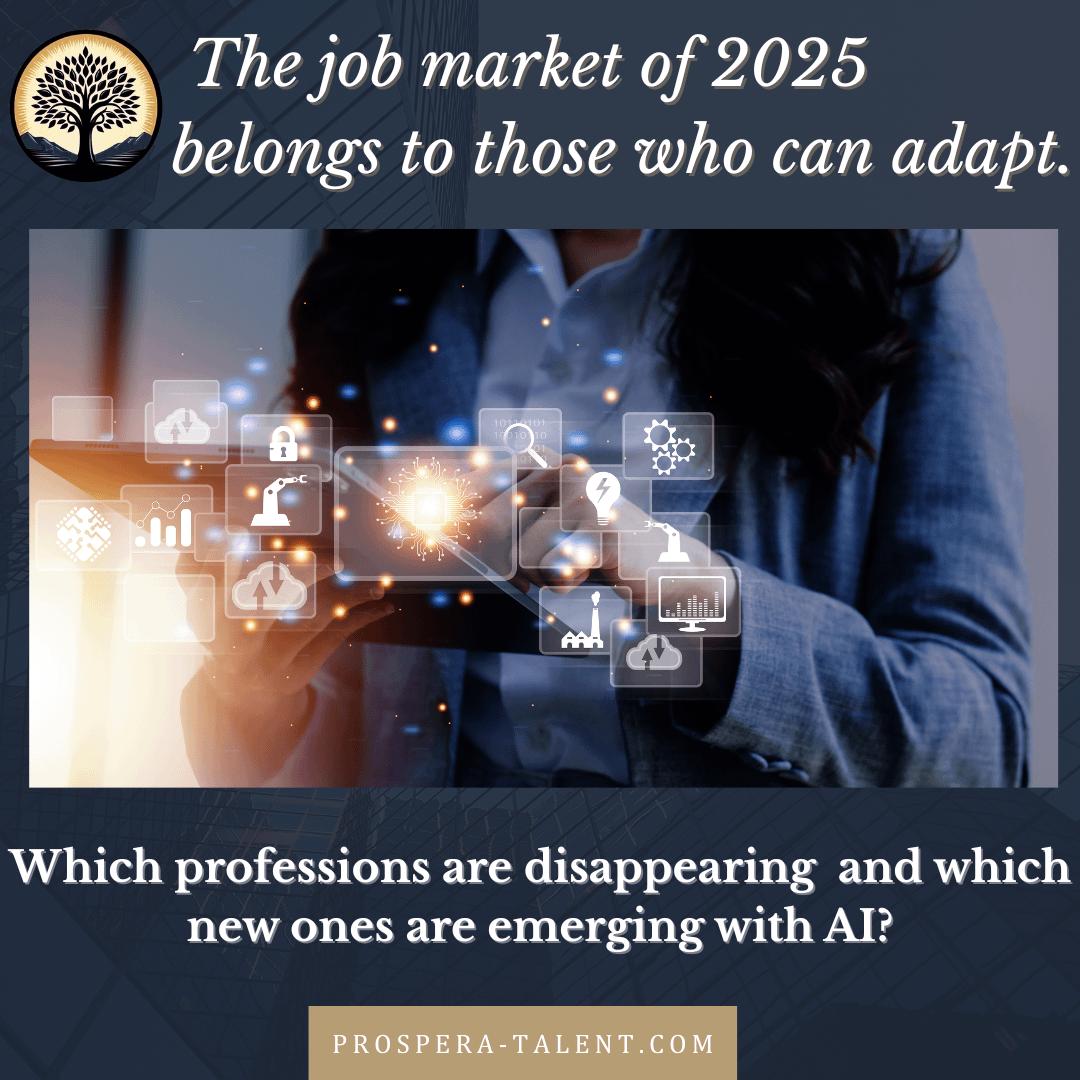
How Artificial Intelligence Is Reshaping the Job Market: Disappearing Roles, Emerging Professions, and Workforce Adaptation

Artificial Intelligence (AI) is no longer a buzzword. It has become a defining force behind today’s economy, business models, and workforce transformation.
In 2025, AI’s influence is visible across every sector — from finance and logistics to education and healthcare.
Companies are rethinking workflows, automating repetitive processes, and integrating AI into daily operations. This shift is transforming how we work and what skills are valued.

AI doesn’t simply replace humans — it redefines the structure of work itself, creating new forms of collaboration between people and technology.

 Roles at Risk: Professions Likely to Disappear or Shrink

Job disappearance is a gradual process, but automation is already reducing demand for certain roles built on routine, repetitive tasks.

Among the most affected:

29May

A Topic No One Likes to Talk About: How HR Should Respond to Harassment, Discrimination, and Retaliation

In any company—big or small, startup or international corporation—there can be moments that test not only the employee involved, but the entire organization.
Harassment, discrimination, and retaliation aren’t just legal terms. They represent real experiences that can destroy trust within a team, damage a company’s reputation, and severely affect someone’s career, well-being, and mental health.

At Prospera Talent Agency, we increasingly see HR professionals feeling unsure:
How should I react? When should I step in? What does the law say? Where is the line between an awkward joke and a violation of rights?

What These Terms Really Mean

Harassment isn’t always loud scandals. Sometimes it’s a series of “harmless” comments, personal questions, or innuendos that build an atmosphere of discomfort or humiliation.

Sexual harassment is a specific type of harassment involving unwanted sexual behavior or remarks.

Discrimination happens when someone is judged or treated unfairly not for their skills or performance, but based on gender, age, race, disability, religion, and other protected characteristics.

Retaliation is the most insidious reaction—when someone who speaks up faces silent punishment: being excluded, getting fewer tasks, or being let go. All of that is illegal.

The Law Exists — But It’s Not Always Enough

Different countries have strong legal frameworks. But laws only protect people if companies actually apply them in real life.

 In the U.S.:Federal laws like Title VII require employers to actively prevent and investigate harassment.
EEOC receives tens of thousands of complaints each year—many of them about retaliation.

 In the UK:The Equality Act 2010 allows employees to file a claim even without first reporting to HR. And tribunals often side with the employee.

 In Switzerland:The Equality Act requires companies to ensure a safe environment. If they fail to act, they are legally liable—even if the employer wasn’t directly involved.

Why HR Is a Key Player

Many HR professionals hesitate to escalate complaints. Some hope the situation will resolve on its own. Others fear management backlash.
But in reality, HR is often the only person who can prevent a crisis—not just legal, but reputational and cultural.

To do that, you have to go beyond policies and PDFs and ask yourself:
What would we do if this story came out in the press tomorrow?

What HR Must Do — Not in Theory, but in Practice

1. Make policies clear and human.
If your anti-harassment policy takes 10 pages to read and needs a lawyer to understand — no one will follow it. Use plain language and real examples. Break it down by role: what a manager should do, what an employee should do, what HR does.

2. Offer safe ways to report.
Anonymous forms, internal reporting channels, trusted contacts — the more options, the more likely someone will speak up.

3. Provide real training, not just formal checkboxes.
A harassment training shouldn’t just be slides with definitions. Use real scenarios, quotes that seem like “just jokes” but actually hurt. Let managers role-play tough conversations.

4. Respond quickly — and visibly.
When a complaint comes in, you can’t wait. Even if you’re unsure where to begin, showing that HR is listening and taking action matters.

5. Watch out for retaliation.
Often, employees aren’t afraid to report harassment — they’re afraid of what happens after. HR must monitor whether someone is being quietly excluded, ignored, or demoted after speaking up.

One Problem, Many Contexts

If your company operates in multiple countries, there is no one-size-fits-all solution.
Laws, norms, and cultural expectations vary greatly.

What you should do:

  • Review labor laws in every country where you operate.
  • Adapt policies to local realities.
  • Train local managers in their own language and legal context.

What You Can Do Today

  • Review your current harassment and retaliation policy: is it clear and relevant?
  • Meet with managers — not for a lecture, but a discussion. Ask them where they feel unprepared or confused.
  • Create a simple “what to do if…” roadmap for employees.
  • Run an anonymous safety survey: do employees feel safe? Do they know where to go for help?

In Conclusion

You can’t prevent every incident. But you can create a culture where no one has to face it alone.
Where HR is not a bystander, but a guardian.
Where compliance is not a checkbox, but a shared value.
Where company culture is more than a slogan — it’s how people behave every day.

If you’re ready to build a real prevention strategy in your company, Prospera Talent Agency can help — from policy to culture, from audits to action.

📬 hr@prospera-talent.com
🌐 prospera-talent.com

HRLeadership #WorkplaceSafety #HarassmentPrevention #InclusiveWorkplace #PeopleFirst #TrustCulture #RetaliationAwareness #HRCompliance #RespectAtWork #DiversityEquityInclusion

06May

Early Signs Your Employee May Be About to Quit: How to Recognize and Respond

Employee turnover can be costly — not just financially, but in terms of time, lost knowledge, and team morale. When a high-performing team member suddenly resigns, it often feels like a shock. But in most cases, there are clear warning signs well before the resignation letter lands on your desk.

In this post, Prospera Talent Agency shares how to spot early indicators of potential resignation — and what HR professionals can do to retain talent and reduce the risk of unexpected departures.

 10 Early Warning Signs an Employee Is Thinking About Leaving

24Apr

Generation Z in the Job Market: How to Attract and Retain Young Talent

Generation Z — born approximately between 1996 and 2010 — is no longer just entering the job market in 2025; they are actively shaping it. Successfully hiring and retaining Gen Z talent requires flexibility, digital readiness, and an understanding of their values. In this blog, Prospera Talent Agency shares key recommendations for companies that want to attract and retain Gen Z professionals.

Who Are Gen Z Professionals?
Gen Z grew up with technology, constant online access, and information overload. They are:
Digital natives: smartphones, social media, and messaging apps are part of their everyday life;
Independent and mindful: they value freedom of choice and meaningful work;
Highly adaptable: they easily learn new technologies and processes;
Strongly focused on work-life balance, more so than previous generations.

What Matters Most to Gen Z When Choosing a Job?
🔹 1. Company Values and Mission
Gen Z seeks purpose, not just a paycheck. They want to work for companies whose values align with their own — sustainability, inclusivity, social responsibility, and transparency.
✅ Tip: Clearly communicate your mission and values. Promote them on your website, social media, and in job descriptions.

🔹 2. Career Growth and Learning Opportunities
Gen Z wants continuous development. They will not stay in a company where they don’t see a clear path for growth.
✅ Tip: Offer development plans, mentorship, access to online training, and opportunities to explore different roles within the company.

🔹 3. Flexible Work Approach
Flexibility, remote work, and trust are essential for Gen Z. They care about results, not hours spent in an office.
✅ Tip: Provide hybrid work models, flexible hours, and a results-based approach to performance.

🔹 4. Digital Culture Within the Company
Gen Z expects work processes to be digital—from onboarding to daily tasks.
✅ Tip: Automate workflows and use modern tools like Slack, Notion, Zoom, Trello, etc. Make digital integration a part of your company culture.

🔹 5. Transparent Communication and Feedback
Young professionals want open and equal communication. They value regular feedback, honesty, and involvement in decision-making.
✅ Tip: Establish a feedback culture. Make communication regular and informal. Involve Gen Z employees in planning and strategy discussions.

How to Attract Gen Z Candidates
Use social media and video content: TikTok, Instagram, and YouTube are their go-to platforms.
Share employee stories and showcase company culture from the inside.
Keep job descriptions short, clear, and visually engaging.
Use language that’s relatable but respectful.
Highlight flexibility, purpose, and growth in every job post.

How to Retain Gen Z Employees
Build a transparent and flexible company culture.
Create a sense of purpose and impact in their work.
Provide opportunities for both vertical and lateral growth.
Foster human relationships: managers should act as mentors, not controllers.
Be open to suggestions and innovation from younger team members.

Conclusion
Gen Z is not a “challenge,” but an opportunity to reinvent the way we work and build businesses. Companies that learn to communicate with young professionals in their language will earn loyal, creative, and adaptable employees.

📩 Looking to hire promising young professionals? Contact Prospera Talent Agency — we’ll match you with candidates who align with your company not only by experience but also by values.

GenerationZ #YoungTalent #WorkWithGenZ #HiringTrends2025 #Recruitment #ProsperaTalentAgency

15Apr

Why You Still Need External Recruiting Support — Even with an Internal HR Team

How Prospera can strengthen your hiring process and support your team at every stage


Introduction: It’s not either-or — it’s “both together”

We hear this a lot:

“We already have an HR team. Why would we need an external recruiter?”

It’s a fair question. But let’s reframe it:

Even if you have a lawyer in-house — would you never consult a legal firm for specific cases?

It’s the same with hiring.

📌 In today’s market, even the best internal HR teams need outside support sometimes — not because they’re doing something wrong, but because the workload is growing, roles are changing, and hiring is more complex than ever.

At Prospera, we don’t replace your HR team.
We enhance it — with speed, flexibility, and strategic expertise.
We support HR teams by taking on specific tasks they simply don’t have time or bandwidth for — especially when things start moving fast.

07Apr

How to Speed Up Hiring Without Losing Quality: A Step-by-Step Guide

Intro

Fast doesn’t have to mean sloppy.

In today’s talent market, speed is a competitive advantage. Top candidates won’t wait weeks for a slow process — they’ll go where the action is. But how do you accelerate hiring without sacrificing quality or making the wrong hire?

The key lies in structure, clarity, and using the right tools. Below are 7 proven steps to hire faster — and smarter.

02Apr

A Real Story: Why Even Strong HR Teams Sometimes Need External Support

“We’ve got it under control. Our HR team can handle it.”
That was the first thing we heard from one of our clients — a large tech company with offices in Miami and Orlando.

And they weren’t wrong: they had a solid HR team of four, experienced recruiters, structured processes, an ATS in place, templates for everything, a well-oiled machine.

So why did they come back to us just two months later?