
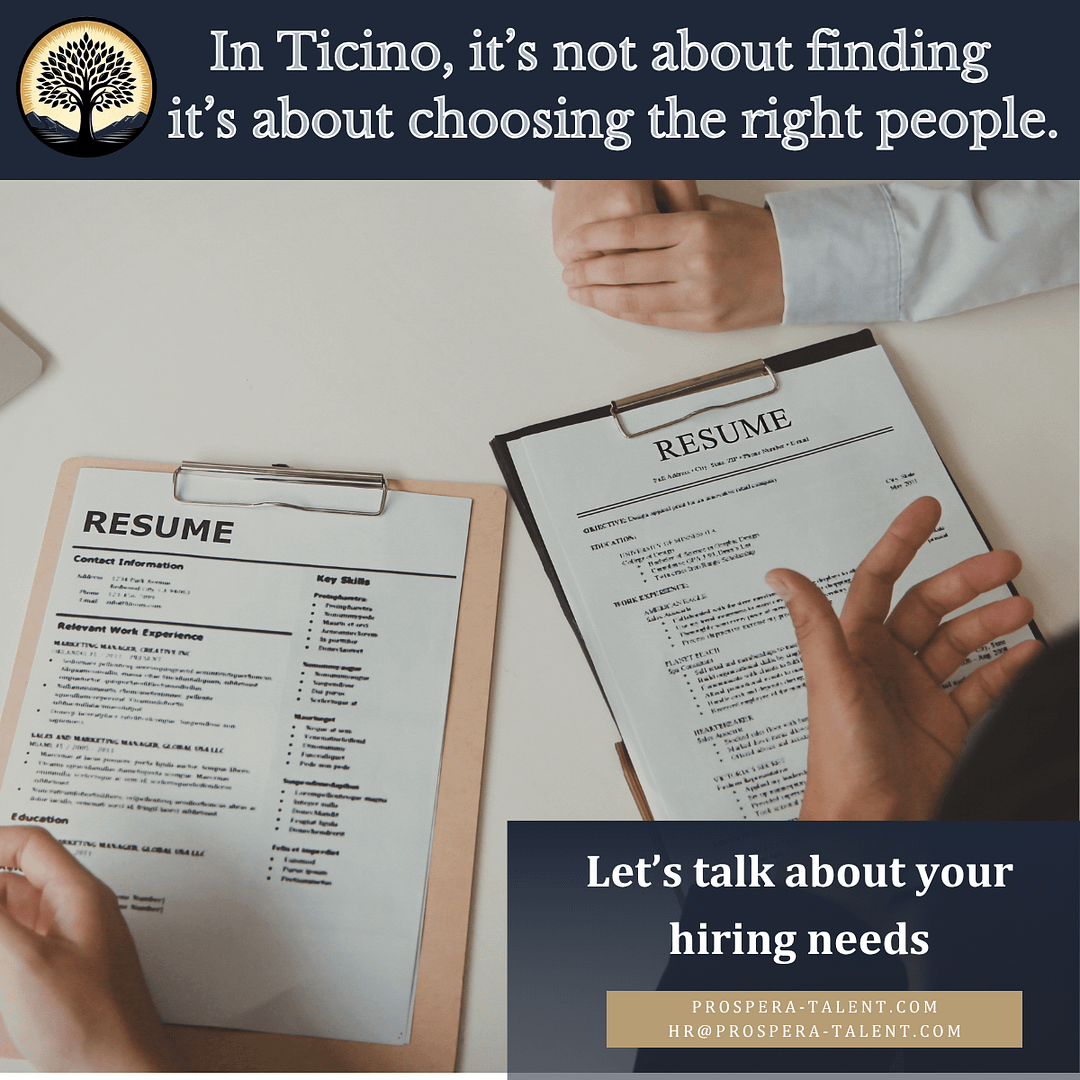
The labor market in Ticino is not just a local market.
It is a compact, highly competitive, and to a large extent closed ecosystem.
On one side, there is a high number of small and medium-sized businesses, often operating with limited internal resources.
On the other, there is a shortage of qualified professionals and strong competition for top talent.
At this intersection, a key question emerges:
why is recruitment today no longer an option, but a strategic necessity?
1. The illusion of choice: many candidates, few truly suitable
At first glance, the market appears active: vacancies are published, applications are received.
But behind the volume lies a quality issue.
Companies regularly face the following challenges:
- candidates do not match the level of responsibility required
- experience exists on paper but is not relevant to the specific business context
- lack of cultural fit within the team
- soft skills do not align with the company’s working dynamics
As a result, the hiring process becomes a “CV screening exercise” rather than a strategic selection.
The true value of recruitment lies in filtering and interpretation,
not simply in sourcing.
A strong recruiter evaluates not only experience, but also potential, motivation, and alignment with the business context.
2. The passive talent market: where the best candidates really are
One of the defining characteristics of Ticino is its limited talent pool.
At the same time:
- most strong professionals are already employed
- they are not actively looking for new roles
- they are not present on job boards
This is what we call the “passive market.”
And this is where real competition between employers takes place.
Accessing these candidates requires:
- direct search
- personalized outreach
- trust and reputation
Recruitment agencies act as a bridge between companies and this hidden talent market.
3. The cost of a hiring mistake: hidden business losses
Hiring mistakes are often underestimated.
Companies tend to consider only salary costs, while ignoring the real impact:
- management time spent on hiring and onboarding
- lost opportunities (delayed projects, slowed growth)
- negative impact on team performance and engagement
- reputational risks
In smaller teams, this impact is significantly amplified.
One wrong hire can cost not only money, but also momentum.
Professional recruitment reduces this uncertainty through:
- more accurate candidate evaluation
- structured processes
- clear alignment of expectations and motivation
4. The absence of a structured HR function
In Ticino, many companies do not have a dedicated HR function.
Typically:
- responsibilities are split between management and administration
- there is no structured hiring process
- decisions are often made intuitively
This leads to:
- unclear role definitions
- misaligned expectations within the team
- lack of evaluation criteria
In this context, a recruitment agency is not just a supplier,
but a strategic partner.
It brings structure where there is none.
5. Recruitment as a business diagnostic tool
One of the most underestimated aspects of recruitment is its diagnostic role.
Before starting a search, it is essential to understand:
- what problem the new hire needs to solve
- what the real priorities are
- which competencies are truly critical
Very often, it becomes clear that:
- the role is too broadly defined
- expectations are unrealistic
- or the company is looking for a “perfect candidate” who does not exist
A strong recruiter helps refine and clarify the role before the search begins.
This alone can save months.
6. Time as a critical business resource
For CEOs and business leaders, hiring is one of the most time-consuming processes.
It involves:
- reviewing dozens (sometimes hundreds) of CVs
- conducting interviews
- coordinating steps
- internal discussions
And yet, it is not their core expertise.
By delegating recruitment, companies regain focus.
Instead of managing the process, they receive:
- a shortlist of relevant candidates
- a clear selection logic
- support in decision-making
7. Access to quality, not quantity
The difference between internal hiring and working with an agency lies in candidate quality.
Recruitment agencies:
- work with pre-qualified candidates
- build long-term relationships
- know how to position opportunities effectively
This allows companies to attract candidates who would otherwise never consider the role.
8. Flexibility in a changing market
The labor market is evolving faster than internal company processes.
Today, businesses need to:
- fill key roles quickly
- adapt to change
- scale their teams
A recruitment partner provides this flexibility without the need to build internal structures.
Conclusion
In the Ticino market, recruitment is no longer an operational task.
It becomes:
- a risk management tool
- a driver of growth
- a source of competitive advantage
Companies that understand this
do not just hire faster — they hire better.
If your company is currently growing or planning to strengthen its team,
it may be worth starting not with a job posting.
But with a question:
do we truly understand who we are looking for — and why?
At Prospera Talent Agency, this is where we begin.
Because strong hiring does not start with CVs
it starts with clarity inside the business.