28Jul

How HR Professionals Can Stay Relevant in the Age of AI: Future-Proof Skills and Human Value

Artificial Intelligence is transforming how we search, evaluate, and manage talent.
What used to take days — from CV screening to engagement analysis — now happens in seconds. ATS platforms sort resumes, chatbots handle initial communication, and People Analytics platforms can predict employee burnout before it happens.

But the more technology enters the HR space, the more we need to ask:
If algorithms can do the job, what’s left for HR professionals?

Let’s explore which skills will remain vital, where AI is already embedded in HR, and where its potential is still underused.

16Jul

Why Summer Is the Perfect Time for Quiet Hiring of Top Talent

Summer is often seen as the “slow season” in recruitment — people are on vacation, business activity drops, and hiring decisions get postponed.
But in reality, summer can be a strategic opportunity for companies that think ahead.

At Prospera Talent Agency, we often encourage our clients to use this period for quiet, focused hiring — especially when it comes to key roles and high-level professionals.

09Jul

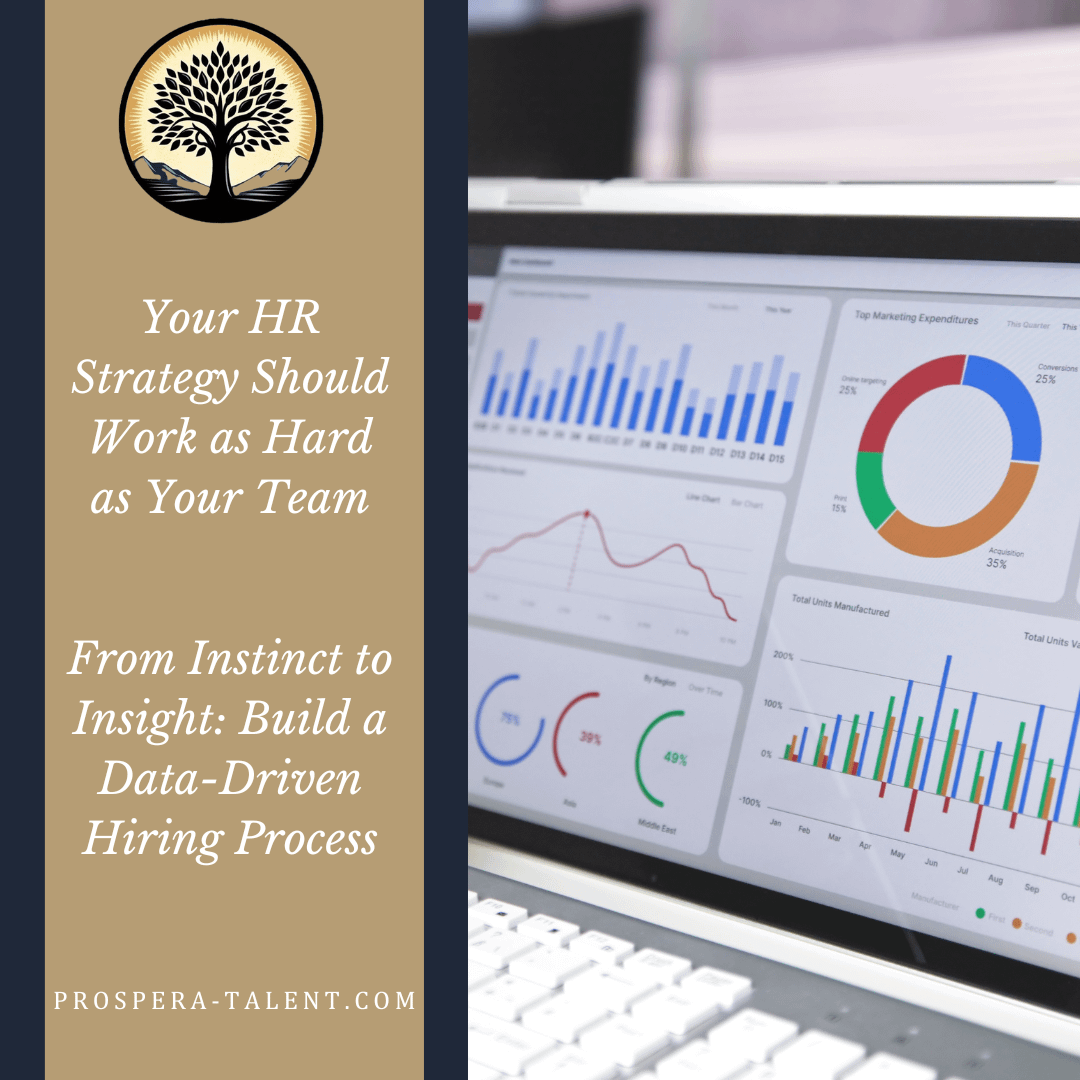
HR Metrics: Why They Matter and How They Drive Business Results

In today’s data-driven world, HR is no longer just about people — it’s about performance, strategy, and measurable impact.
HR metrics give companies the tools to understand how well their workforce is performing, how effective their hiring processes are, and where they need to improve to stay competitive.

At Prospera Talent Agency, we believe that great hiring starts with great data. That’s why we work with our clients to implement HR strategies backed by meaningful, actionable metrics.

Why HR Metrics Matter

HR metrics help organizations:

  • Diagnose weak points in recruitment, onboarding, retention, and performance
  • Make data-driven decisions (not guesswork)
  • Optimize hiring costs and timelines
  • Justify HR initiatives to leadership
  • Predict talent needs and workforce trends
  • Strengthen employer branding and employee experience

 Key HR Metrics and How to Use Them

1. Employee Turnover Rate

Formula:
(Number of employees who left ÷ Average total employees) × 100%

 What it tells you: Overall retention and stability. High turnover may signal poor onboarding, lack of engagement, or misalignment with company culture.

 Use it to:

  • Separate voluntary vs. involuntary turnover
  • Analyze trends by department or team
  • Trigger exit interviews and feedback loops

2. Time to Hire

Formula:
Date of job acceptance – Date job was posted

 What it tells you: The speed and efficiency of your recruitment process.

 Use it to:

  • Identify bottlenecks in the hiring workflow
  • Benchmark performance by role or recruiter
  • Improve candidate experience

3. Cost per Hire

Formula:
(Total recruitment cost ÷ Number of hires)

 Includes: job ads, recruiter salaries, agency fees, onboarding, software, etc.

 Use it to:

  • Measure ROI of hiring channels
  • Optimize recruitment budget
  • Compare internal vs. external hiring costs

4. New Hire Retention Rate

Formula:
(Number of new hires still employed after 3–6 months ÷ Total new hires) × 100%

 What it tells you: The quality of hire and effectiveness of onboarding.

 Use it to:

  • Evaluate recruitment sources and selection process
  • Improve onboarding programs
  • Reduce early attrition

5. Employee Engagement Score

💬 Usually measured via anonymous surveys or eNPS (employee net promoter score).

 Use it to:

  • Track how motivated and committed employees feel
  • Identify risks of burnout or disengagement
  • Align internal culture with business goals

6. Internal Mobility Rate

Formula:
(Number of internal moves ÷ Total open roles) × 100%

 What it tells you: Career growth opportunities and employee development inside the organization.

Use it to:

  • Promote career pathing
  • Build succession plans
  • Improve retention through internal promotion

Where to Track Your Metrics

  • ATS (Applicant Tracking Systems) – e.g., Workable, Greenhouse, Recruitee
  • HRIS (HR Information Systems) – e.g., BambooHR, PeopleForce
  • Google Sheets / Excel – for early-stage tracking
  • Pulse Surveys – via Google Forms, Officevibe, CultureAmp
  • CRM/ERP tools – for tying HR data to performance or sales

How to Implement HR Metrics in Your Company

  1. Define your business goals and match relevant metrics
  2. Automate data collection wherever possible
  3. Visualize metrics with dashboards for clarity
  4. Benchmark against industry standards
  5. Share insights with leadership to drive strategic decisions
  6. Adjust regularly — metrics should evolve with your company

💡 Final Thoughts

HR metrics are not just “nice to have” — they’re essential for building a smarter, more resilient, and more effective workforce.
At Prospera Talent Agency, we help companies go beyond filling positions — we support them in creating sustainable hiring strategies built on data, insight, and long-term value.

📩 Want to know which metrics your business should be tracking?
Let’s talk — we’d be happy to guide you.

24Jun

Training That Works: Why, When, and How to Measure It

In a fast-changing business world, training and development are no longer optional — they’re strategic. But to make training truly effective, companies must understand why they need it, when it’s necessary, and how to measure its impact.

At Prospera Talent Agency, we help businesses build training programs that don’t just look good on paper — they actually drive performance and growth.

 Why does training matter?

01Jun

Why It’s Crucial to Understand Real Labor Market Data Today

The job market in 2025 is dynamic, unstable, and complex.
Every month, something changes — new professions emerge, old ones disappear, companies lay off workers and then hire again just as quickly.

In such conditions, making career decisions blindly means losing time, money, and opportunities.

To understand where to go, who is looking for your skills, and what is actually valued on the market — you need data.
Fresh, accurate, and relevant to your profession.

📍 Why Is Labor Market Data So Important?

The world of work is no longer the same for everyone. That’s why information has become the key to career success:

1.  Market volatility

Jobs and industries rise and fall quickly.
Without data, you might spend an entire year applying for jobs that no longer exist in practice.

2.  Each state is its own labor market

The U.S. is not one market, but fifty.
What’s in demand in Texas might be irrelevant in Florida.
Some places pay more, others less — and job competition also varies.

3.  Salaries vary widely

Even with the same job title, working conditions, remote options, bonuses, and workload can be dramatically different.
With data, you avoid settling for less than what you deserve.

4.  Career management requires strategy

Data helps you not just get a job, but build a career strategy — what to learn, where to apply, and where the long-term opportunities are.
You need to manage your career like a project.

5. Technology is reshaping everything

AI and automation are changing the job landscape fast.
If you don’t adapt, your skillset may quickly become outdated.
To adapt — you need to know what’s already shifting.

👩‍💼 Why It Matters for Candidates

1. See where your profession is in demand

In one state, your experience may be gold — in another, completely unnecessary.
Skillora helps you identify where you are truly needed.

2. Compare job conditions and make better choices

Get a clear picture of salary ranges, remote work availability, working hours, and job requirements — so you can choose the best offer, not just the first.

3. Understand your competition

Fewer applicants = higher chance of being hired.
Data lets you estimate this before applying.

4. Create a realistic development plan

Skillora identifies related roles that match your experience and shows you what skills to learn to reach the next level.

5. Get real, personalized recommendations

Not just “apply more” — but “You’d be a strong fit for roles in Texas if you improve Skill X.”
Skillora gives actionable advice, backed by data.

🔍 What Is Skillora.me?

Skillora.me is a digital analytics platform for job seekers.
It was built to help you understand where your skills are needed — and find jobs based on facts, not luck.

This is not a job board.
This is not a recruitment agency.

It’s your personal career navigator, built on big data and smart algorithms.

⚙️ How Does Skillora.me Work?

  1.  You upload your resume (CV)
  2.  The system analyzes your experience, skills, and key phrases
  3. You receive:
    • A breakdown of where your profession is in demand
    • Salary benchmarks by location
    • Tips on how to improve your profile
    • Career recommendations and next steps

 Skillora Uses Big Data

Skillora processes hundreds of thousands of job postings and resumes every day.
It uses automation, machine learning, and real-time market data to give you a clear, personalized career view.

You don’t see “everything” — only what’s relevant to your goals and experience.

🌎 Where Is Skillora.me Available?

Right now, Skillora is available in three key U.S. states:

California, Texas, Florida

These states were chosen first because of their active labor markets, wide range of industries, and high hiring activity.

Conclusion

Finding a job today isn’t about luck — it’s about information.
The better you understand the market, the better your chances of landing the job you truly want (and deserve).

Skillora.me is your career assistant, analyst, and guide — all in one.
Just upload your resume — and discover where your future begins.

👉 Try Skillora.me

29May

A Topic No One Likes to Talk About: How HR Should Respond to Harassment, Discrimination, and Retaliation

In any company—big or small, startup or international corporation—there can be moments that test not only the employee involved, but the entire organization.
Harassment, discrimination, and retaliation aren’t just legal terms. They represent real experiences that can destroy trust within a team, damage a company’s reputation, and severely affect someone’s career, well-being, and mental health.

At Prospera Talent Agency, we increasingly see HR professionals feeling unsure:
How should I react? When should I step in? What does the law say? Where is the line between an awkward joke and a violation of rights?

What These Terms Really Mean

Harassment isn’t always loud scandals. Sometimes it’s a series of “harmless” comments, personal questions, or innuendos that build an atmosphere of discomfort or humiliation.

Sexual harassment is a specific type of harassment involving unwanted sexual behavior or remarks.

Discrimination happens when someone is judged or treated unfairly not for their skills or performance, but based on gender, age, race, disability, religion, and other protected characteristics.

Retaliation is the most insidious reaction—when someone who speaks up faces silent punishment: being excluded, getting fewer tasks, or being let go. All of that is illegal.

The Law Exists — But It’s Not Always Enough

Different countries have strong legal frameworks. But laws only protect people if companies actually apply them in real life.

 In the U.S.:Federal laws like Title VII require employers to actively prevent and investigate harassment.
EEOC receives tens of thousands of complaints each year—many of them about retaliation.

 In the UK:The Equality Act 2010 allows employees to file a claim even without first reporting to HR. And tribunals often side with the employee.

 In Switzerland:The Equality Act requires companies to ensure a safe environment. If they fail to act, they are legally liable—even if the employer wasn’t directly involved.

Why HR Is a Key Player

Many HR professionals hesitate to escalate complaints. Some hope the situation will resolve on its own. Others fear management backlash.
But in reality, HR is often the only person who can prevent a crisis—not just legal, but reputational and cultural.

To do that, you have to go beyond policies and PDFs and ask yourself:
What would we do if this story came out in the press tomorrow?

What HR Must Do — Not in Theory, but in Practice

1. Make policies clear and human.
If your anti-harassment policy takes 10 pages to read and needs a lawyer to understand — no one will follow it. Use plain language and real examples. Break it down by role: what a manager should do, what an employee should do, what HR does.

2. Offer safe ways to report.
Anonymous forms, internal reporting channels, trusted contacts — the more options, the more likely someone will speak up.

3. Provide real training, not just formal checkboxes.
A harassment training shouldn’t just be slides with definitions. Use real scenarios, quotes that seem like “just jokes” but actually hurt. Let managers role-play tough conversations.

4. Respond quickly — and visibly.
When a complaint comes in, you can’t wait. Even if you’re unsure where to begin, showing that HR is listening and taking action matters.

5. Watch out for retaliation.
Often, employees aren’t afraid to report harassment — they’re afraid of what happens after. HR must monitor whether someone is being quietly excluded, ignored, or demoted after speaking up.

One Problem, Many Contexts

If your company operates in multiple countries, there is no one-size-fits-all solution.
Laws, norms, and cultural expectations vary greatly.

What you should do:

  • Review labor laws in every country where you operate.
  • Adapt policies to local realities.
  • Train local managers in their own language and legal context.

What You Can Do Today

  • Review your current harassment and retaliation policy: is it clear and relevant?
  • Meet with managers — not for a lecture, but a discussion. Ask them where they feel unprepared or confused.
  • Create a simple “what to do if…” roadmap for employees.
  • Run an anonymous safety survey: do employees feel safe? Do they know where to go for help?

In Conclusion

You can’t prevent every incident. But you can create a culture where no one has to face it alone.
Where HR is not a bystander, but a guardian.
Where compliance is not a checkbox, but a shared value.
Where company culture is more than a slogan — it’s how people behave every day.

If you’re ready to build a real prevention strategy in your company, Prospera Talent Agency can help — from policy to culture, from audits to action.

📬 hr@prospera-talent.com
🌐 prospera-talent.com

HRLeadership #WorkplaceSafety #HarassmentPrevention #InclusiveWorkplace #PeopleFirst #TrustCulture #RetaliationAwareness #HRCompliance #RespectAtWork #DiversityEquityInclusion

15Apr

Why You Still Need External Recruiting Support — Even with an Internal HR Team

How Prospera can strengthen your hiring process and support your team at every stage


Introduction: It’s not either-or — it’s “both together”

We hear this a lot:

“We already have an HR team. Why would we need an external recruiter?”

It’s a fair question. But let’s reframe it:

Even if you have a lawyer in-house — would you never consult a legal firm for specific cases?

It’s the same with hiring.

📌 In today’s market, even the best internal HR teams need outside support sometimes — not because they’re doing something wrong, but because the workload is growing, roles are changing, and hiring is more complex than ever.

At Prospera, we don’t replace your HR team.
We enhance it — with speed, flexibility, and strategic expertise.
We support HR teams by taking on specific tasks they simply don’t have time or bandwidth for — especially when things start moving fast.

07Apr

How to Speed Up Hiring Without Losing Quality: A Step-by-Step Guide

Intro

Fast doesn’t have to mean sloppy.

In today’s talent market, speed is a competitive advantage. Top candidates won’t wait weeks for a slow process — they’ll go where the action is. But how do you accelerate hiring without sacrificing quality or making the wrong hire?

The key lies in structure, clarity, and using the right tools. Below are 7 proven steps to hire faster — and smarter.

16Mar

How Tenure Analysis Can Help Companies and HR Agencies

Introduction

In today’s job market, understanding how long employees stay in companies across different industries is essential. Employee tenure data provides insights into workforce stability, turnover trends, and hiring challenges. Prospera Talent Agency offers data-driven solutions to help both businesses and HR agencies make informed talent management decisions.

In this analysis, we examined tenure data from various industries in Florida, including Retail, Marketing, IT, Hospitality, Staffing & Recruiting, as well as 10 related sectors. This data helps businesses identify turnover risks, industry trends, and workforce planning opportunities.